The Body’s Secret Armor: Wilhelm Reich’s Radical Synthesis of Biology, Psychology, and the Energy of Life
Introduction: The Body as a Living Record
Why does emotional trauma so often manifest as a physical knot in the stomach or a chronic rigidity in the shoulders? For Wilhelm Reich, a brilliant yet divisive protégé of Sigmund Freud, the answer was not merely psychological—it was biological. Early in his career, Reich became frustrated by what he termed “therapeutic misery,” a sense of “unending stalemates” where traditional talk therapy failed to release the “dammed-up” energy of his patients. He observed a “paucity of technical support” for analysts, noting that there were often as many techniques as there were analysts.
Archival records suggest that Reich’s shift from the “talking cure” to the body was born from this clinical frustration. He realized that the mind’s defenses were anchored in the tissues of the body, creating a physical record of a person’s history. This led to the development of Medical Orgone Therapy, an attempt to find the biological reality of the libido and bridge the historic gap between the “Physiker” (those focused on matter and quantity) and the “Psychiker” (those focused on form and quality).
Your Personality is a Physical “Suit of Armor”
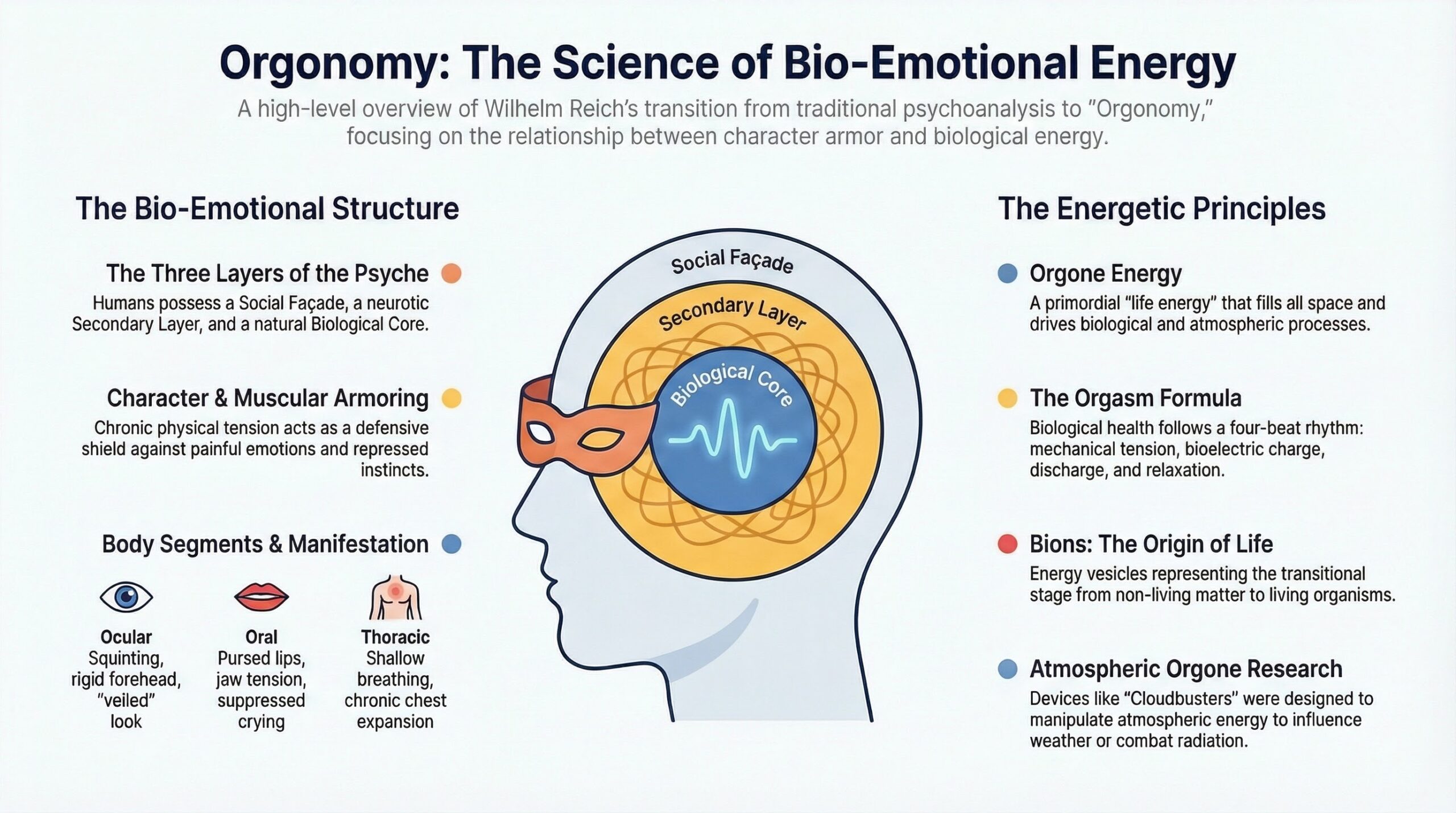
Reich’s most enduring contribution is the concept of “Character Armor” and its somatic twin, “Muscular Armor.” He argued that a person’s character—their specific mode of existence—acts as a psychic protection mechanism. This armor is a “mechanism of psychic protection” that defends the individual against both the “outer world” and their own “unconscious instincts.”
According to Reich’s journals and clinical notes, this armor is not a metaphor but a systematic distribution of chronic muscular tension. He identified seven distinct segments of armor that inhibit the natural flow of life energy:
- Ocular: Tension in the eyes and forehead, often appearing as a “veiled” or “suspicious” look.
- Oral: Muscles of the mouth, jaw, and throat; related to crying or sucking.
- Cervical: Deep neck muscles, functioning to “hold the head up” or maintain vigilance.
- Thoracic: Chest and shoulders, often manifested as chronic inspiratory holding.
- Diaphragmatic: The midsection, creating a “respiratory block” that splits the body’s upper and lower functions.
- Abdominal: Tension in the belly and lower back.
- Pelvic: Tension in the pelvic floor, often the root of “orgastic impotence.”
Reich described the individual as being trapped within this rigidity, writing in The Technique of Character Analysis:
“The individual is armored against the outer world but also against his own unconscious instincts.”
Schizophrenia and the “Ocular Block”
In his pursuit of a unified theory of mental illness, Reich turned to the most severe cases of schizophrenia. He drew on Eugen Bleuler’s concept of “splitting,” but provided a biological explanation: a split between “psychic perception” and “somatic excitation.” Archival clinical cases from 1948 describe schizophrenic patients as experiencing a “emotional inferno” where they detach from their own biological processes.
This “splitting” is rooted in the ocular segment. Reich observed that in the schizophrenic, the eyes “don’t go with it”—the organism refuses to integrate the eyes into the total biological function. Poignantly, Reich traced this to the newborn baby who, in attempting to grasp the world with its eyes for the first time, “meets with nothing,” encountering only hostility or threat.
The therapeutic response was a breakthrough in psychiatric history. Dr. Elsworth Baker, a key figure in the field, later identified the “ocular stage” of development, fulfilling a dream shared by Freud and Bleuler of a “definitive convergence of psychiatry and psychoanalysis.” Practitioners used penlights to trigger eye movements or applied pressure to the nape of the neck to “desensitize” the ocular segment, helping the patient tolerate the terrifying increase of energetic charge and reintegrate their perception with reality.
The Three Layers of the Human Core
By 1942, Reich had refined his topographic theory of the human psyche into three distinct layers:
- The Social Façade: The polite, reserved, and “conscientious” exterior presented to society. Reich believed this surface layer has no direct contact with the core in the “average man.”
- The Secondary Layer: The realm of the Freudian Unconscious, containing “cruel, sadistic, rapacious, and envious impulses.”
- The Biological Core: The deepest, undistorted part of the psyche, found in newborns and animals. This core is characterized by natural, healthy impulses and “biological aliveness.”
The most surprising claim of Medical Orgone Therapy is that our darkest impulses are not primary. Reich argued that the “Secondary Layer” is a distortion created by the repression of the natural core. He believed that if the armor of the social façade and the secondary layer could be dissolved, the “primary” biological core would emerge, capable of genuine love and productive work.
The “Orgasm Formula” as a Universal Law
Reich sought a common functioning principle (CFP) for all life, which he codified as the “Orgasm Formula.” This four-beat rhythm—Mechanical Tension → Bioelectric Charge → Bioelectric Discharge → Mechanical Relaxation—was, in his view, a universal law. He observed it in the expansion and contraction of the heart, the lungs, and even the movement of an amoeba’s protoplasm.
This led to his discovery of “Orgone Energy.” For Reich, Orgone represented a synthesis of the “Physiker” (quantitative/material) and “Psychiker” (qualitative/formal) systems of thought. He called this methodology “Functionalism,” a thought technique that operates in the same way as nature herself. It suggests that sexuality (expansion/pleasure) and anxiety (contraction/fear) are two variations of the same underlying vegetative current—a literal biological energy that could be measured and manipulated.
The “Spacegun” and the War with UFOs
The final phase of Reich’s career remains the most counter-intuitive. In 1954, while at his research facility in Rangeley, Maine, Reich reported encounters with “Enigma Alpha” (Ea), or UFOs. He became convinced these crafts were propelled by Orgone and were “hostile,” poisoning the atmosphere and creating deserts through “deadly orgone radiation.”
Reich adapted his “Cloudbuster”—an array of pipes designed to draw energy out of the sky—into what he called a “Spacegun.” During the “Battle of Tucson” in Arizona, which Reich described as a “Planetary Valley Forge,” he attempted to defend the Earth and “green” the desert. According to his journal, Contact With Space, the arrival of two “radium needles” allowed him to charge the device and clear “tremendous black clouds” that triggered Geiger counter readings of 100,000 counts-per-minute.
Archival records and Reich’s correspondence indicate a surprising level of interest from the military. Lt. Steven J. Hebert of the Presque Isle Air Force Base provided Reich with UFO reporting questionnaires, and General Harold Watson, chief of intelligence at Wright-Patterson Air Force Base, showed a “tacit interest” in Reich’s claim to have disabled alien craft, despite the FDA’s concurrent legal battle to label Reich’s work as quackery.
Conclusion: A Bridge Between Mind and Matter
Medical Orgone Therapy remains a provocative attempt to create an “integrative bridge” between the sciences of the body and the psyche. By moving beyond the “talking cure” to address the physical armor that holds our history, Reich’s work suggests that true health is synonymous with “biological aliveness.”
As modern psychiatry leans increasingly toward pharmaceuticals and discrete symptom management, we are left to wonder if something essential has been lost. If our character is indeed “wired” into our muscles, as Reich’s research suggests, have we lost the ability to see the mind-body relationship as a singular, energetic function? Perhaps the “armor” we carry is the most significant barrier to the “love, work, and knowledge” that Reich believed were the hallmarks of a healthy life.
.